
Legal frameworks
- · US DMCA Section 512
- · EU Copyright Directive (2019/790)
- · EU Digital Markets Act (gatekeeper OTAs)
- · UK Copyright, Designs and Patents Act
- · Australian Copyright Act
- · Berne Convention (global baseline)
Bowerbird Technologies removes your hotels from unauthorised and rogue OTAs — helping to restore rate parity, reclaiming direct bookings and protecting your hotel brand.
A rogue OTA (or unauthorised online travel agent) is a third-party website that sells your hotel rooms without a contract. It scrapes your imagery, descriptions and rates, lists you on Google and metasearch, and quietly intercepts demand that should come directly to you. Rogue OTAs typically use a mix of tactics including bait and switch, add hidden fees, break parity, all of which are damaging to your brand's trust — costing the average hotel 5–15% of direct revenue every year.
Bowerbird Technologies removes rogue OTAs wherever they surface — across the major booking channels, metasearch and 50+ long-tail aggregators — using DMCA enforcement, opt-out management and geo-aware copyright and trademark law.
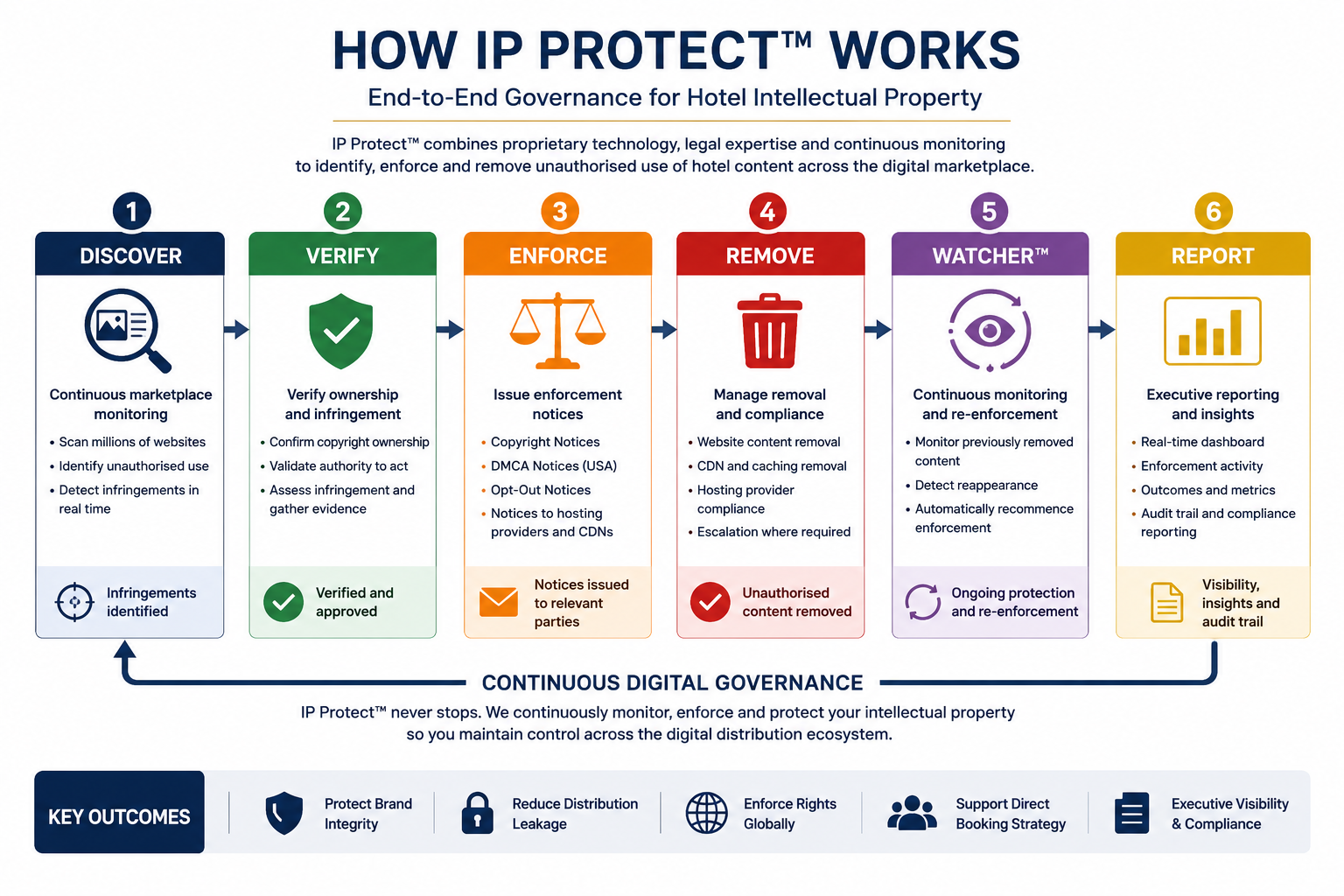
Bowerbird enforces rights you already hold under the world's harmonised copyright frameworks. Every takedown is auditable, every notice is legally compliant, every action is logged.
Unauthorised online travel agents sell your rooms without approval — adding hidden fees, breaking parity and damaging the relationships you spent years building.
Every reservation made through an unauthorised third party comes with commission fees that quietly compound across the year.
OTAs intercept communication — limiting loyalty programs, upsells and personalisation opportunities.
Algorithms and parity rules decide how your hotel is displayed, ranked and priced.
Guests remember the OTA, not the hotel — weakening recognition and long-term loyalty.
A three-step AI-driven enforcement loop that runs every minute of every day across every market you sell into.
Bowerbird continuously scans the web for unauthorised use of your brand, imagery and content. You decide which OTAs to remove — exercising the rights you already hold as the owner of that content.
AI-driven analysis triggers DMCA takedowns, red-flag reports and geo-tailored opt-outs. Rogue listings lose content, ranking and bookability — managed transparently in your IPP dashboard.
Rogue OTAs return. The 24/7 AI Watcher detects re-uploads and new infringements, automatically reissuing takedowns so your team never lifts a finger.
Built for every property size
Under 100 rooms. Flexible OTA coverage. Start with the rogue listings that hurt the most.
Explore plan101–1,000 rooms. Multi-property monitoring with consistent brand control across portfolios.
Explore plan1,000+ rooms or multi-brand operators. Unlimited takedowns. Enterprise-grade coverage.
Explore planPartnership
AI-based commercial operating system Lighthouse has partnered with Bowerbird Technologies, targeting rate parity issues caused by third parties listing hotel rooms without permission and undercutting the hotel’s own channels.
Lighthouse’s Parity Insight tool tracks parity in real time across hundreds of distribution channels, surfacing not just isolated mismatches but the recurring offenders behind the most significant parity loss. Bowerbird then uses existing copyright mechanisms to remove those listings and monitor them to prevent reappearance — a detect-and-enforce loop.
“Unauthorised listings quietly erode brand trust, push up acquisition costs and divert revenue hotels have already earned. Together, we can solve this at a scale the industry has never seen.”
FAQ
A rogue or unauthorised online travel agent (OTA) is a third-party website that sells your hotel rooms without a contract, scraping your imagery, room descriptions and prices. They inflate rates, add hidden fees, break parity, intercept direct demand and erode brand trust — costing hotels an average of 5–15% of direct revenue every year.
Bowerbird's Intelligent Protection Platform (IPP) uses AI to continuously scan the web for unauthorised use of your hotel's copyrighted images and content. When found, IPP issues DMCA takedowns, red-flag reports, hosting complaints and geo-tailored opt-outs. Listings lose their imagery, ranking and bookability — usually within days.
Yes. Your hotel owns the copyright on your images, descriptions and brand identity. Bowerbird only enforces rights you already hold under DMCA (US), the EU Copyright Directive, the Australian Copyright Act and equivalent legislation worldwide. We never take action without your authorisation.
Most rogue OTA listings lose their imagery within 3–7 days and become commercially unviable within 14 days. AI Watcher then monitors continuously and auto-reissues takedowns if the listing re-appears.
Bowerbird monitors every major OTA and metasearch platform, plus thousands of long-tail aggregators, affiliate sites and rogue resellers. The Volume plan offers unlimited coverage.
Both. Bowerbird's Variable plan starts from a small number of OTAs and is built for properties under 100 rooms. Standard fits mid-sized hotels and groups (101–1,000 rooms). Volume is for global chains needing unlimited takedowns and multi-brand protection.
Book a 20-minute demo and see how Bowerbird removes rogue OTAs from your distribution within days.